
How to Find Anne Arundel County Arrest Records
An arrest creates a booking record first. When someone is taken into custody in the county, they are processed into a jail run by the Anne Arundel County Department of Detention Facilities. The fastest public window into that booking is the county Inmate Locator. It is free. It shows where a person is held, the bail set, and upcoming court dates for people currently in a county jail. The Detention Facilities phone line is 410-222-7374.
Booking and court data are not the same file. The jail roster tells you a person is in custody right now. The charges, pleas, and outcome sit in the court system. To pull both, search the locator for current custody, then move to Maryland Judiciary Case Search for the case. The steps below follow the normal flow for a recent arrest.
- Open the county Inmate Locator and search by exact first and last name, or by the jail ID number.
- Read the result for current location, housing, bail amount, and listed court dates.
- Note the linked Circuit Court or District Court case numbers shown on the profile.
- Take those case numbers to Maryland Judiciary Case Search to read charges and disposition.
- Check the Sheriff's active warrant list if no booking shows but a warrant may exist.
- Call Detention Facilities at 410-222-7374 to confirm custody status when the online record is unclear.
The locator needs an exact name match. John Doe will not return Jon Doe. If you have it, the jail ID number is the surer route. For a deeper case history, the Anne Arundel County court records page walks through the full Case Search portal.
The Anne Arundel County Booking Process
Booking is the intake step that turns an arrest into a record. The county jail logs the person, sets a jail ID, and begins screening. Two facilities handle this work. Jennifer Road Detention Center in Annapolis is the main intake and pretrial site. Ordnance Road Correctional Center in Glen Burnie leans toward sentenced inmates and programs.
Health checks start fast. A nurse does a medical screening and a mental health screening within four hours of arrival. A full physical exam, including tuberculosis and STD testing, happens within 14 days. These steps are part of intake, not the public record, but they shape where a person is housed. People with mental health needs may go to the Behavioral Observation Unit at Jennifer Road.
Bail is handled away from the jail. You cannot pay bail at a detention facility. Bail is paid during business hours at the District or Circuit Court clerk, or after hours at the Commissioner's Office. For people committed by a District Court Commissioner, a bail review hearing is held the next court day by closed-circuit television at 10:30 a.m. and 1:30 p.m. at the Annapolis District Court on Rowe Boulevard. After a release order or bail payment, release usually takes 2 to 6 hours once the documents reach the jail.
Anne Arundel County Inmate Locator Search Fields
The locator uses a short form. You search by name or by jail ID. Both first and last name are required for a name search, and the match must be exact. The table lists the fields and how each one works.
| Field Label | Type | Required | Notes / Format |
|---|---|---|---|
| First Name | Text | For name search | Exact match with last name; John will not find Jon |
| Last Name | Text | For name search | Exact match with first name |
| JID | Text | Alternative | Jail ID number; search by JID alone is allowed |
| Search | Button | n/a | Runs the lookup |
| Clear | Button | n/a | Resets the form |
Note: If you enter too little, the tool warns that you must provide either a JID number or both a first and a last name.
What Anne Arundel County Arrest Records Show
People expect a mugshot and a charge list on the jail roster. The county locator does not work that way. The official result script shows custody and case data, not photos or charge text. Charges are reached through the linked court cases. The list below maps the fields the locator actually returns.
- Name and jail ID number (JID)
- Sex and date of birth
- Current location and current housing
- Bail amount
- Court date or dates
- Circuit Court case numbers
- District Court case numbers
The 2-column table sums up the most-asked-about fields and what each one tells you.
| Field | What It Shows |
|---|---|
| Current Location | The facility holding the person now, such as Jennifer Road or Ordnance Road |
| Bail Amount | The dollar bail set, or a no-bail status, for the current hold |
| Court Date(s) | Scheduled hearing dates tied to the custody |
| Case Number(s) | Linked Circuit and District Court cases that hold the charges |
Note: The county locator does not post mugshots or charge text, so a no-record result can simply mean the person is no longer in a county jail.
Arrest Record vs Criminal Court Record
An arrest record and a criminal court record are two different files. The arrest record starts at booking and lives with the jail and police. The criminal court record starts when a charge is filed and lives with the court. One can exist without the other. A person can be arrested and never charged, and a charge can be filed without a jail booking. The comparison table breaks down the split.
| Arrest Record | Criminal Court Record |
|---|---|
| Created at booking by the jail | Created when a charge is filed in court |
| Held by Detention Facilities and police | Held by the Circuit or District Court clerk |
| Shows custody, housing, bail, court dates | Shows charges, pleas, verdicts, sentences |
| Found through the county Inmate Locator | Found through Maryland Judiciary Case Search |
| Reflects the moment of arrest | Reflects the full life of the case |
For the full case story, the court file is the better source. It carries the charges with statute references, the docket, and the final disposition. Booking data answers a narrower question: is this person in custody, and on what bail. Use the court records page for case history and the inmate records page for a deeper jail-roster walkthrough.
Charges vs Convictions in Anne Arundel County Criminal Records
A charge is not a conviction. This is the single most misread part of any arrest or criminal record. A charge is what the State accuses a person of. A conviction is a finding or admission of guilt. Many charges end in dismissal, acquittal, or a nolle prosequi, which means the State chose not to go forward. Reading a record without that distinction leads to bad conclusions.
| Charge | Conviction |
|---|---|
| An accusation filed by the State | A guilty finding or guilty plea |
| Appears at or near arrest | Appears at case disposition |
| May be dropped, dismissed, or won | Carries a sentence or penalty |
| Does not prove guilt | Establishes legal guilt |
Where a case is heard depends on the offense. The District Court of Maryland handles many misdemeanors, traffic crimes, initial appearances, and preliminary hearings. The Circuit Court handles felonies and jury trials. A misdemeanor can start in District Court, while a felony moves to Circuit Court through indictment, information, or a preliminary hearing. DUI and DWI matters can route into criminal court too, and the traffic court records page covers that overlap.
Warrants and the Anne Arundel County Sheriff
Some people are wanted but not yet in custody. That falls to the Anne Arundel County Office of the Sheriff, which keeps a public active warrant list. A warrant can come from a failure to appear, a probation violation, an unpaid obligation, or contempt. The list is informational only.
The Sheriff's homepage is the entry point for warrant and civil-process information in the county.
The online warrant list is not real-time and is not complete. It is updated weekly and includes only unserved county warrants active for six months or longer. Recently served warrants can linger until the next update. Treat a hit as a lead, not as proof, and confirm with the Sheriff, the clerk, or counsel. The warrant records page covers the active warrant search and the tip form in detail.
Restricted and Confidential Arrest Records
Not every arrest or criminal record is open. State law closes several categories. Juvenile records are restricted under Courts and Judicial Proceedings § 3-8A-27, so public Case Search should not be relied on for juvenile matters. Expunged records leave public view by court order. Shielded records limit public access while staying open to some justice agencies. Grand jury material and mental health commitment files stay sealed as well.
Public access to court case records runs under the Maryland Rules and Judiciary policy, while county and police administrative files use the Maryland Public Information Act. The general right to inspect public records sits in Maryland Code, General Provisions § 4-201, unless another law blocks access. A custodian must deny a request when release would break another law or a court order.
- Expungement
- A court-ordered removal of eligible police and court records from public access.
- Shielding
- A process that limits public access to certain conviction records without erasing them for every government use.
- Nolle prosequi
- A formal notice that the State will not proceed on a charge.
- Probation before judgment
- A disposition that can avoid a conviction and may open a path to expungement after a waiting period.
Expungement and Shielding of Anne Arundel County Arrest Records
Maryland lets people clear eligible arrest and criminal records. Expungement is petition-based unless a law makes it automatic for a category. A person files in the court where the case ended, names the case number and disposition, and serves the required parties. The right to ask comes from Criminal Procedure § 10-105.
Eligibility turns on the outcome and the waiting period. Common eligible outcomes include acquittal, dismissal, nolle prosequi, probation before judgment for eligible offenses after a wait, and certain nonviolent convictions after set periods. If the court grants the petition, the order tells courts, police, and related agencies to pull eligible records from public access. Common denials come from filing too early, an ineligible offense, a pending case, a later disqualifying conviction, or an objection by the State.
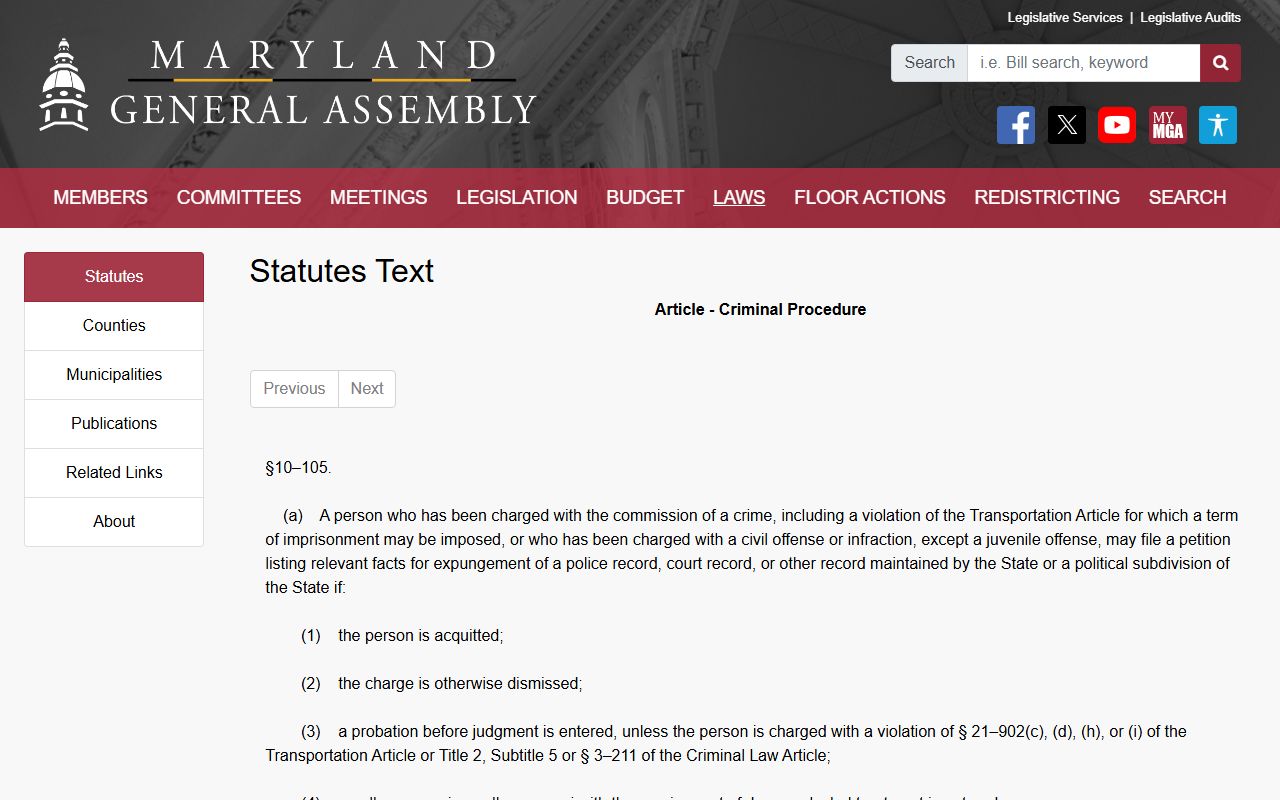
The official statute text shows the eligibility and process rules in full.
Shielding is a separate tool. Under Criminal Procedure § 10-110, shielding limits public access to certain convictions after waiting periods and conditions, but the records stay open to law enforcement, licensing, and justice agencies. So shielding hides a record from a routine public search without wiping it for every purpose. Free help with both steps is available through the Maryland Courts legal-help system.
Background Checks and Anne Arundel County Criminal Records
Arrest data shows up in background checks, so accuracy matters. A booking entry alone does not prove a conviction. Many records that look damaging end in dismissal or acquittal, and an expunged or shielded record should not appear in a routine public check at all. Reading the court disposition is the only way to know how a case ended.
Two offices shape how a criminal case moves. The Anne Arundel County State's Attorney's Office prosecutes state criminal cases and runs victim and witness services. The Office of the Public Defender represents people who qualify by income and asset limits. A Public Defender representative is assigned to the Detention Facilities to take applications, and a person can apply after bail review or by request form in a housing unit.
The Public Defender office page is the place to start an application or check eligibility.

Victims can stay informed too. The Detention Facilities Records Department takes victim contact information for notification. For sentenced inmates, the victim gets court-appearance calls when relevant, a letter within 30 days of release, and a call on release day. For pretrial detainees, the victim gets court-appearance notices and immediate pre-release notification.
Mental Health Court and Diversion in Anne Arundel County
Not every criminal case ends in a standard sentence. The county runs problem-solving courts for eligible defendants. The Anne Arundel County District Court Mental Health Court reached its first anniversary on December 3, 2025, with a graduation that brought total graduates to 10 in its first year. The program meets at the Glen Burnie District Court at 7500 Ritchie Highway.
Other pathways exist as well. The Detention Center runs a Supervised Release Unit, where a judge at bail review may release a defendant to supervision with conditions like reporting, urinalysis, or treatment. Drug Treatment Court offers court-supervised treatment instead of ordinary probation for screened participants. These programs are not open to everyone. Entry is screened, supervised, and tied to program criteria.