
Who Issues Anne Arundel County Marriage Records
Marriage licenses come from one office. The Clerk of the Circuit Court issues every Anne Arundel County marriage license. Maryland is a county-issued state, so the license is granted locally rather than by a state bureau. The clerk also records the signed license after the ceremony and keeps it on file. That recorded license is the record people later ask for. State vital records may help verify or certify some older marriages, but the live source for a current license is the county clerk.
The clerk's marriage counter sits in the courthouse in downtown Annapolis. The same building handles many other court functions, so the marriage desk is one of several departments under the clerk. Treat the clerk's official marriage page as the truth for the current fee, the ID rules, and the counter hours. Those details can shift, and the page is updated before a printed flyer would be.
Clerk of the Circuit Court
8 Church Circle
Annapolis, MD 21401
410-222-1397
Mon-Fri, business hours
Call ahead if you have a tight timeline. Hours, walk-in rules, and accepted payment types all live on the clerk's page.
How to Apply for an Anne Arundel County Marriage License
The license comes before the wedding, not after. You apply with the clerk, pay the fee, and then wait through the state validity rules before the license can be used. Both people give their basic facts on the application. The steps below follow the normal flow from first visit to recorded record.
- Read the clerk's marriage license page first so you know the fee, the ID rules, and the hours before you go.
- Apply through the Clerk of the Circuit Court for Anne Arundel County, in person at the marriage counter.
- Bring the required identification and information for both applicants.
- Pay the marriage license fee listed by the clerk at the time you apply.
- Observe the Maryland waiting period and validity window before the ceremony date.
- Have the ceremony performed by an officiant authorized under Maryland law.
- Make sure the officiant returns the signed license to the clerk for recording.
- Request certified copies from the clerk once the license is recorded.
The order matters. A license that is used before its valid date, or never returned by the officiant, can leave a gap in the record. Confirm the validity rules with the clerk so the ceremony lands inside the legal window.
Note: The marriage license fee and the exact ID rules are set by the clerk, so verify both on the official marriage page before you plan your visit.
Anne Arundel County Marriage License Application Fields
The application asks both applicants for the same core facts. Most are plain biographical items. A few are sensitive, like the Social Security number, which is collected but not shown to the public. The table lists the common fields and how each one is used.
| Field Label | Type | Required | Notes / Format |
|---|---|---|---|
| Applicant 1 full legal name | Text | Yes | Include a prior name if asked |
| Applicant 2 full legal name | Text | Yes | Include a prior name if asked |
| Date of birth / age | Date / text | Yes | Used to verify eligibility |
| Residence address | Text | Yes | For each applicant |
| Social Security number | Text | Conditional | Restricted identifier, not shown to the public |
| Prior marriage status | Checkbox / text | Yes | Single, divorced, or widowed; give date and place if a prior marriage ended |
| Ceremony / officiant info | Text | May be required | Officiant returns the license after the ceremony |
| Signature / affirmation | Signature | Yes | Each applicant certifies the facts given |
| Payment | Fee | Yes | Verify the current local fee with the clerk |
If a prior marriage ended, you may need the date and place it ended. A divorce decree or a death record can be the proof the clerk wants. Bring that paperwork so the desk does not turn you away.
Anne Arundel County Marriage and Divorce Record Fees
Looking at a public docket online is free. Getting a paper copy is not. Both the marriage record and the divorce record carry charges set by the clerk or the statewide schedule, not by a single local price list. A certified copy is the version a court or an agency will accept, and it costs more than a plain copy. The table below lists the fee items you should expect rather than dollar amounts, since the live numbers are set by the offices that hold the records.
| Fee Item | Amount |
|---|---|
| Marriage license fee | Verify current amount with the Clerk's marriage page |
| Certified copy of marriage license | Verify current amount with the Clerk |
| Divorce filing fee | See the statewide Circuit Court fee schedule |
| Certified copy of divorce decree | Verify current amount with the Clerk |
| Plain copy of a court document | Verify current amount with the Clerk |
| Fee waiver for filing | Request from the Circuit Court Clerk; based on need |
Confirm the current numbers before you pay. The marriage side is priced on the clerk's marriage page, and the divorce side follows the Maryland Judiciary fee schedule. If you cannot afford the filing fee, you can ask the clerk for a waiver. The clerk's Clerk of the Circuit Court page covers the broader copy and request process.
How to Find Anne Arundel County Divorce Records
Divorce records are family records of the Circuit Court. They are not held by a separate divorce bureau. To find one, you first locate the case, then ask the clerk for an official copy of the decree or order. The fastest path is to pull the case number from the statewide case portal, then take that number to the clerk.
Start at Maryland Judiciary Case Search. It is free and covers public Circuit Court case data across the state. Search by the party names, narrow to Anne Arundel County, and read the result for the case number and the family case type. Case Search can show docket entries, but it does not always carry the full document images. For a certified decree, you go to the clerk.
Certified copies of a divorce judgment come from the clerk's Civil Department and Family Division. Bring the case number, the party names, and a way to pay. The same office takes the original divorce filing, so it is the single hub for both starting and copying a divorce case.
Anne Arundel County divorce filings are handled by the Civil Department and Family Division at the courthouse, the office shown below.
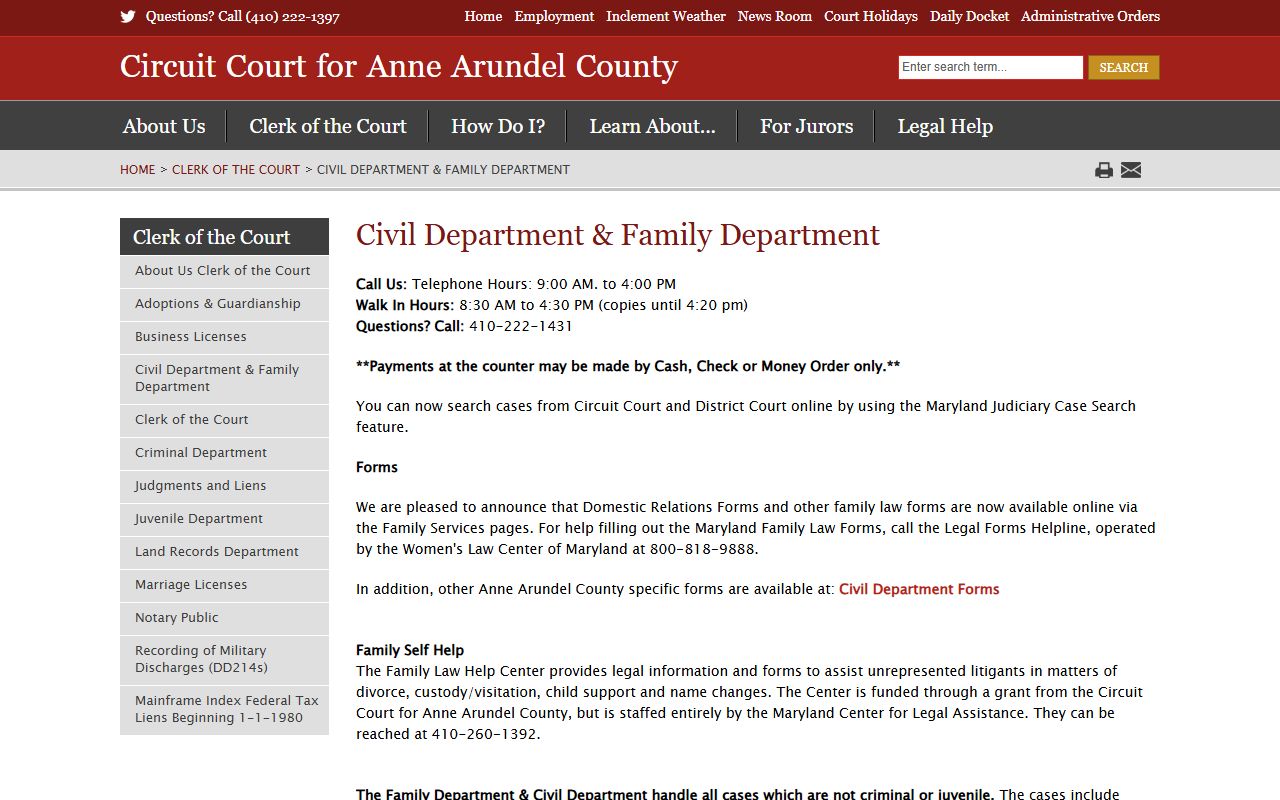
That same division processes the family law forms, schedules the hearings, and signs off on the final judgment, so it is the office to know for any Anne Arundel County divorce record request.
How to File for Divorce in Anne Arundel County
A divorce case moves through several steps before a judge signs the final order. The filing starts with the clerk and ends with a recorded judgment. The steps below follow the usual path under Maryland family law.
- Confirm you meet the residency rule and have valid grounds under Maryland law.
- Complete the Maryland Judiciary family law forms for your case type.
- File the forms with the Circuit Court Clerk's Civil Department and Family Division.
- Pay the filing fee, or submit a fee waiver request if you cannot pay.
- Serve the other party so they get formal notice of the case.
- Attend any scheduling, mediation, settlement, or merits hearings the court sets.
- Obtain the signed judgment of absolute divorce once the court rules.
- Request certified copies from the clerk as you need them.
The official family law forms live in the Maryland Judiciary family forms index. Pick the forms that match your situation, since the packet differs for cases with children, property, or support. Filing fees follow the statewide schedule noted above, and a waiver is available if money is the barrier.
Service of the other party is a step people often miss. The court cannot move forward until the respondent is properly served and the proof is on file.
Public Access to Anne Arundel County Divorce Records
Divorce files are broadly public, but not fully open. The basic docket entries, the case number, and the final judgment are usually visible to the public. Around that core sit several items the court keeps back. Family cases often touch money, children, and safety, so the rules guard those parts even when the case itself is public.
The items below are commonly restricted in an Anne Arundel County divorce file.
- Financial statements filed by either party
- Settlement details and private agreements
- Child custody evaluations and related reports
- Abuse-sensitive information tied to protective matters
- Sealed exhibits the court closes by order
So a public search may show that a divorce was granted and when, while the deeper papers stay limited. To view a restricted item, you usually must be a party, an attorney of record, or someone the court allows by order. If the case overlaps with juvenile, adoption, or guardianship matters, even tighter rules apply.
Note: Seeing a divorce on the public docket does not mean every document in the file is open, since financial and child-related papers are often restricted.
Marriage Verification and State Vital Records
The county clerk holds the recorded marriage license, and that is the right office for most copy requests. The clerk records the signed license after the officiant returns it, then issues certified copies on request. For a recent Anne Arundel County marriage, the clerk is the single best source.
State vital records can come into play for verification or certification of some marriages, often for older records or out-of-county needs. The split is simple to keep straight. The county clerk issues and records the license; the state side may certify or verify in certain cases. When you are not sure which office holds an older record, start with the county clerk and ask where the file lives.
Name changes after marriage are a common reason people pull a certified copy. A certified marriage record is the proof most agencies want to update a driver's license, a passport, or a bank account.