
What an Anne Arundel County Court Docket Shows
A docket is the chronological record of a case. Each line marks an event: a complaint filed, a summons issued, an answer, a motion, an order, a hearing, a postponement, a trial, or a final disposition. The docket does not hold the documents themselves. It tells you they exist and when they were filed, so you can request the ones you need from the clerk.
For an active case, the docket is the fastest way to confirm the next court date and the courtroom. For a closed case, it shows the path to the result. Both Circuit Court and District Court matters carry docket entries in the statewide portal.
The Anne Arundel County Daily Docket
The Circuit Court for Anne Arundel County publishes a daily docket online. It lists the cases set for the day, the courtroom, the hearing type, and the assigned judge where public. It is the tool to use the night before a hearing or the morning of, to confirm where to go.
The official page is the Circuit Court daily docket.
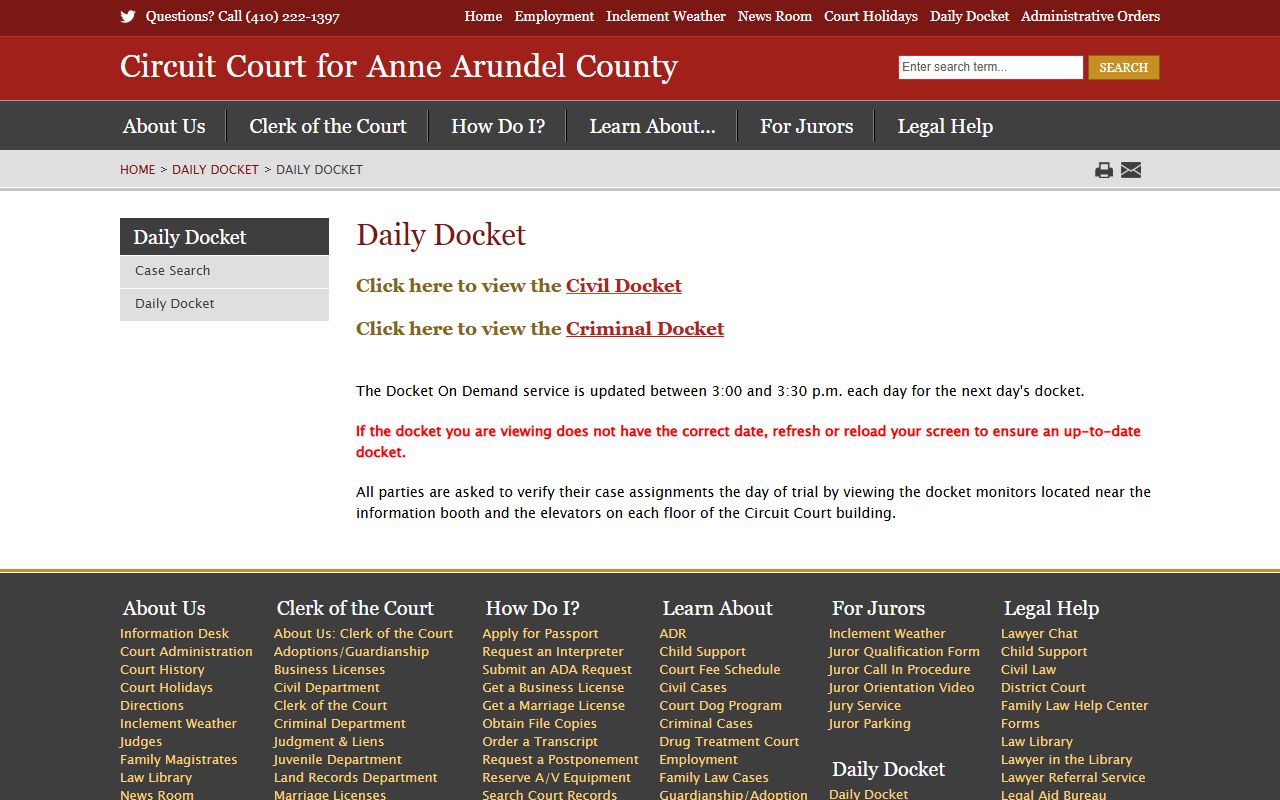
The daily docket is best for same-day scheduling. For a case that is not on today's list, or for the full event history, the statewide case portal is the better source.
Reading Anne Arundel County Docket Entries
A daily docket row holds a small set of fields. The table maps what each one tells you, so a long schedule reads quickly.
| Field | What It Shows |
|---|---|
| Case number | The Circuit Court ID for the file |
| Party / caption | The public party names or case caption |
| Hearing type | Motion, trial, conference, sentencing, and more |
| Courtroom / judge | The courtroom assignment and judicial officer |
| Date / time | When the matter is set to be heard |
In the case portal, the docket runs deeper. Each filing and order appears with its date, which builds the case timeline from the first paper to the last.
How to Find a Docket in Anne Arundel County
To pull the docket history for a case, use Maryland Judiciary Case Search. It carries the event list for public Circuit and District Court matters. The steps below get you to the entries.
- Open Maryland Judiciary Case Search and accept the terms.
- Search by party name or by case number if you have it.
- Narrow to Anne Arundel County and the court that heard the case.
- Open the case to view the docket and event history.
- Note the document dates, then request copies from the clerk if you need the filings.
For a hearing happening today, skip the portal and check the daily docket instead. It is updated for the current court session.
Common Docket Terms
Docket entries lean on shorthand. A short glossary clears up the words you meet most when you read an Anne Arundel County docket.
- Motion
- A written request asking the judge to take an action.
- Continuance
- A hearing or trial moved to a later date.
- Disposition
- The outcome of a case or a single charge.
- Order
- A directive signed or entered by a judge.
- Nolle prosequi
- The State drops a charge; not a conviction.
Note: A single docket line rarely tells the whole story, so read the disposition entry before you draw any conclusion about a case.
Which Anne Arundel County Courts Publish Dockets
Docket information comes from more than one place in the county, and each source covers a different slice of the caseload. The Circuit Court for Anne Arundel County posts its own daily docket for jury trials, felony matters, large civil suits, family cases, and appeals from the District Court. The District Court of Maryland does not post a single county daily list the same way, but its case events appear in the statewide portal, and its two county locations in Annapolis and Glen Burnie set their own daily calendars in the courthouse.
Bail and first-appearance scheduling adds another layer. District Court commissioners handle initial commitments and bail decisions around the clock, and bail review hearings for people committed by a commissioner are held the next court day by closed-circuit television at the Annapolis District Court on Rowe Boulevard. Those settings are part of a defendant's record even before a full docket forms.
Federal cases are tracked apart from all of this. A federal docket for an Anne Arundel County matter lives in PACER and the District of Maryland CM/ECF system, not in the state daily docket or Case Search.
Hearing Types on an Anne Arundel County Docket
The hearing-type field on a docket tells you why a case is on the calendar that day. The same case can appear many times as it moves from filing to resolution. The list below covers the settings you see most often.
- Initial appearance or arraignment - the first court date where charges are addressed.
- Motions hearing - the judge rules on a written request before trial.
- Status or scheduling conference - the court sets deadlines and next steps.
- Trial - the merits hearing, by jury in the Circuit Court or by judge in the District Court.
- Sentencing - the penalty is imposed after a conviction or plea.
- Review hearing - common in family, probation, and specialty court matters.
Family and civil cases often route through mediation or a settlement conference before trial. The Circuit Court runs an alternative dispute resolution program, and those events show on the docket as conferences rather than trials.
Appeals and Dispositions on the Docket
A docket does not end at the verdict. It carries the disposition, any sentence or judgment, and notices of appeal. A District Court case can move up to the Circuit Court, often as a new trial, and that appeal opens a fresh docket at the higher court. Circuit Court appeals usually go on to the Appellate Court of Maryland.
When you read the closing entries, focus on the disposition line and any post-judgment motions. Those tell you whether the case is truly over or still moving. A new docket number on appeal means you may need to search again under the higher court.
Postponements and Remote Appearances
Court dates move. A party or attorney can ask the Circuit Court to postpone a hearing, and the request has its own process and form. Some appearances can be made remotely with court approval. Both requests are handled through the court's "How Do I" pages.
The Circuit Court runs a postponement and remote appearance request page. A postponement changes the docket, so check the daily docket or the case portal again after a request is granted. Do not assume a date is gone just because you asked; wait for the order.
How Current Anne Arundel County Dockets Are
Online docket data can trail the paper file. A new filing or a fresh order may not post the same day it is entered. The daily docket reflects the current court session, while the case portal can lag by a short period as clerks update entries. For a date that matters, confirm it twice.
Important: Never skip a court date based on an online docket alone. If a hearing seems to have moved, call the clerk to confirm before you stay home, because a missed date can trigger a warrant.
Dockets Versus Full Case Records
The docket and the case file are not the same thing. The docket is the index. The file holds the actual pleadings, orders, and exhibits. Online docket data is a public window, not a certified record.
When you need the document behind a docket line, request it from the clerk. For the broader picture of what a case file contains, see the Anne Arundel County court records page. For criminal matters, the arrest records page covers charges and dispositions, and the Circuit Court page profiles the trial court that hears the largest cases.