
How Probate Works in Anne Arundel County
Probate is the legal process that settles what a person owned after they die. In Maryland it does not move through the Circuit Court as a normal civil suit. Instead it runs through two linked offices. The Register of Wills is the clerk and record-keeper for estates. The Orphans' Court is the probate court that hears disputes and signs off on key steps. For Anne Arundel County both sit in Annapolis, and the same office page covers them. So when you look for an estate file, you start with the Register of Wills, not Case Search.
The office handles a wide range of estate work. Common matters include opening an estate, filing a will, naming a personal representative, and approving the final accounts. The list below shows the main things probate covers here.
- Opening estates and filing the decedent's will.
- Appointing a personal representative to act for the estate.
- Handling small estates and regular estates under state limits.
- Reviewing inventories, accountings, and creditor notices.
- Approving the distribution of estate assets to heirs.
- Guardianship of property and minor estates in the right cases.
- Caveats and will contests through the Orphans' Court and Circuit Court paths.
If you came here looking for a lawsuit or a money judgment, that is a different track. Those live on the regular court docket. Use the Anne Arundel County court records page for civil and criminal case files instead.
Anne Arundel County Register of Wills Office
The Register of Wills is the front door for probate records in the county. The office takes in wills, opens estates, keeps the estate files, and collects the fees set by state law. Staff can point you to the right form, but they cannot give legal advice. The office sits in the historic core of Annapolis at Church Circle. Confirm the current phone and counter hours on the state Register of Wills site before you go, since both can change.
Register of Wills for Anne Arundel County
8 Church Circle
Annapolis, MD 21401
Mon-Fri, business hours
Orphans' Court for Anne Arundel County
8 Church Circle
Annapolis, MD 21401
Probate court for estate disputes
The official county page lists the office contact, the local team, and links to forms and fees. Verify the current phone number there.
The Register of Wills page for Anne Arundel County shows the office details and probate links.
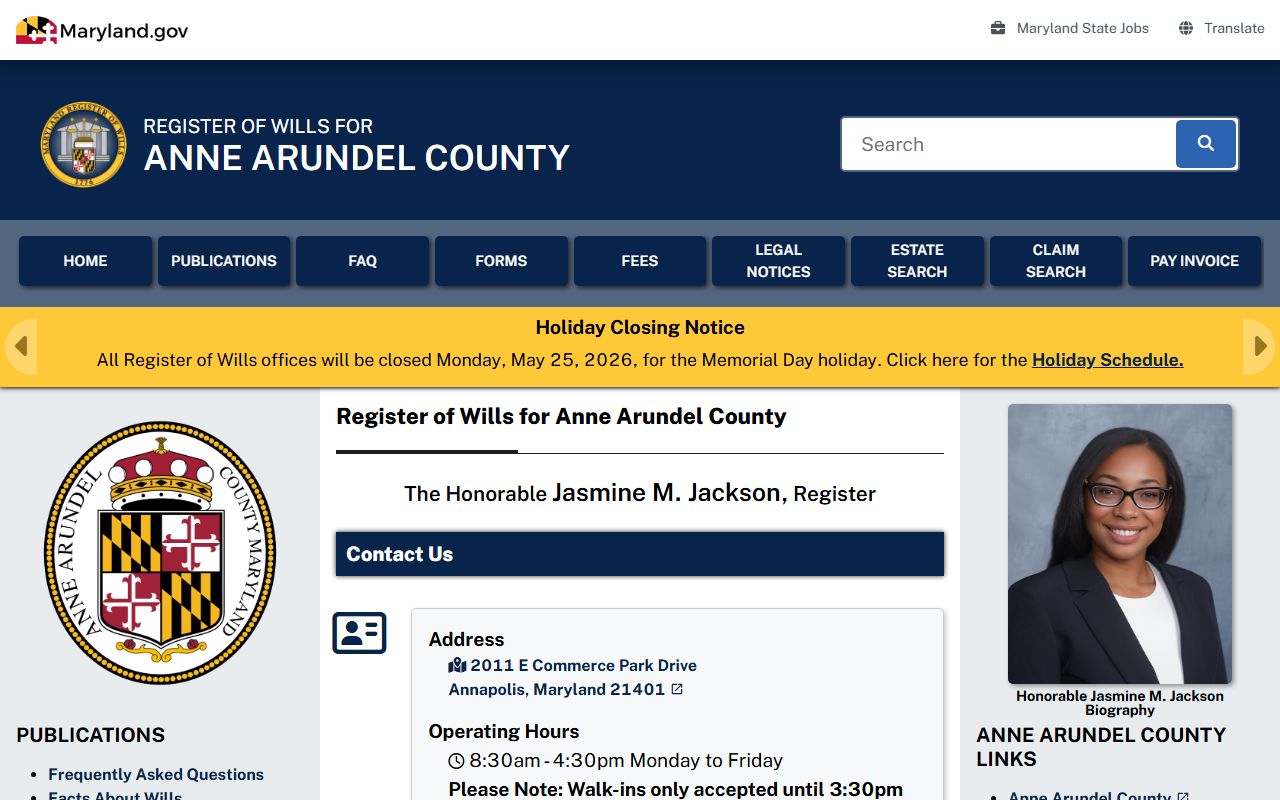
From that page you can reach the statewide forms library and the fee schedule. Both are shared across Maryland, so the same forms and charges apply in every county. The Orphans' Court works hand in hand with the Register and signs the orders that move an estate forward.
Common Anne Arundel County Probate Terms
Probate has its own words, and they trip up a lot of people. Knowing a handful of them makes the file far easier to read. Here are the terms you will see most often in an Anne Arundel County estate record.
- Testator
- The person who made the will. A valid will speaks for the testator after death and names who should get what.
- Executor / Personal Representative
- The person put in charge of the estate. Maryland uses the term personal representative. They gather assets, pay debts, and hand out what is left.
- Intestate
- When a person dies with no valid will. State law then sets who inherits and in what share.
- Guardianship
- A court setup where one person manages the affairs of a minor or an adult who cannot manage their own. Guardianship of property is the estate side of this.
- Conservatorship
- A court role to manage money and property for someone who cannot do it alone. In Maryland this overlaps with guardianship of the property.
These terms show up on petitions, notices, and the docket. If a form uses a word you do not know, the office staff can point you to the right line, even though they cannot explain the law.
How to Search Anne Arundel County Probate Records
Estate records are searched by the name of the person who died, called the decedent. If you have the estate number, the lookup is faster and cuts out the guesswork. You can search at the office counter or through the state Register of Wills system. Have the decedent's full name and a rough date of death ready. The steps below follow the normal flow.
- Start at the Register of Wills page for Anne Arundel County and open the estate search or records link.
- Enter the decedent's last and first name as exactly as you can.
- Set the county to Anne Arundel so the search stays local.
- Add a date of death or filing date if a common name returns too many rows.
- Type the estate number for a direct lookup when you already know it.
- Open the matching estate to read the will, the inventory, and the accounting entries.
- Ask the office for a certified copy when you need an official document.
The search fields are simple. A name plus the county is often enough. The table lists the common fields and how each one works.
| Field Label | Type | Required | Notes / Format |
|---|---|---|---|
| Decedent name | Text | Yes for name search | Last name and first name of the person who died |
| Estate number | Text | Optional | Direct lookup if you already know it |
| County | Dropdown | Yes | Select Anne Arundel County to localize |
| Date of death / filing date | Date | Optional | Narrows a common name |
| Estate type | Dropdown | Optional | Small estate, regular estate, or modified administration where offered |
Note: Estate search labels can shift between updates, so check the live screen before you assume a field is gone or renamed.
Steps of an Anne Arundel County Probate Case
An estate moves through set steps. The Register of Wills records each one, and the Orphans' Court signs off when needed. Knowing the order helps you read where a case stands. Some steps differ for a small estate versus a regular estate, but the spine is the same.
- Find out whether the person who died left a will.
- File the will and the opening papers with the Register of Wills.
- Decide if the estate is a small estate or a regular estate under Maryland limits.
- The court appoints a personal representative when that fits.
- Notice goes out to interested persons and to creditors.
- An inventory and an information report or accounting get filed.
- Claims against the estate are sorted out and paid or denied.
- Assets are handed out to the heirs.
- The final accounting and closing papers are approved.
Small estates move faster and need less paperwork. Regular estates take longer because the inventory, the accounting, and the creditor period all run on a clock set by state law. The decedent's debts come before any gift to heirs.
Anne Arundel County Probate Forms
Maryland uses one statewide forms library for probate. That means the same form works in Anne Arundel County as in any other county. The forms cover each step, from opening the estate to closing it out. You file them with the Register of Wills, either at the counter or by the method the office allows.
The most-used probate forms include the following.
- Petition for Administration to open a regular estate.
- List of Interested Persons naming the heirs and others with a stake.
- Schedule of Assets and the Inventory of estate property.
- Notice of Appointment for the personal representative.
- Information Report and the Account filings.
- Small-estate forms for estates under the state limit.
You can pull every current form from the state library. Grab the right version before you file, since older forms get retired.
The statewide forms page lists each probate form by name and stage.
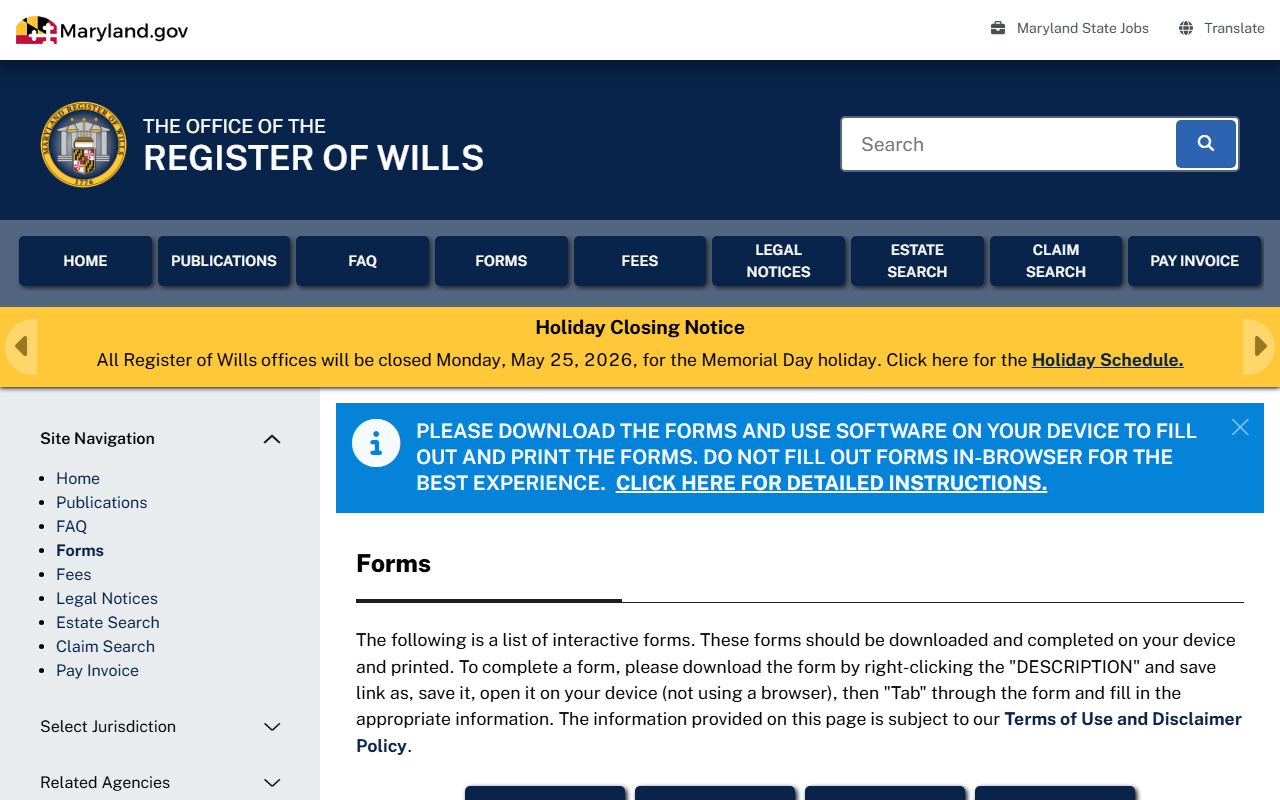
Find the full set at the Register of Wills statewide forms page. If you are not sure which form fits your estate, the office can point you to it.
Anne Arundel County Probate Fees
The Register of Wills charges fees set by Maryland law, not by the county. Probate fees often scale with the size of the estate, and copies carry their own charge. Because the numbers can change, the table below lists the fee items only and points you to the official schedule. Always confirm the current amount before you pay.
| Fee Item | Amount |
|---|---|
| Estate opening / probate fee | Verify current amount |
| Small estate fee | Verify current amount |
| Plain copies of estate documents | Verify current amount |
| Certified copies | Verify current amount |
| Will filing for safekeeping | Verify current amount |
| Recording or other service fees | Verify current amount |
The official numbers live on the state fee page. Maryland often ties the probate fee to the value of the estate, so a larger estate pays more. Check the Register of Wills fee schedule for the exact, current charges.
The fee schedule page sets out each charge in plain terms.
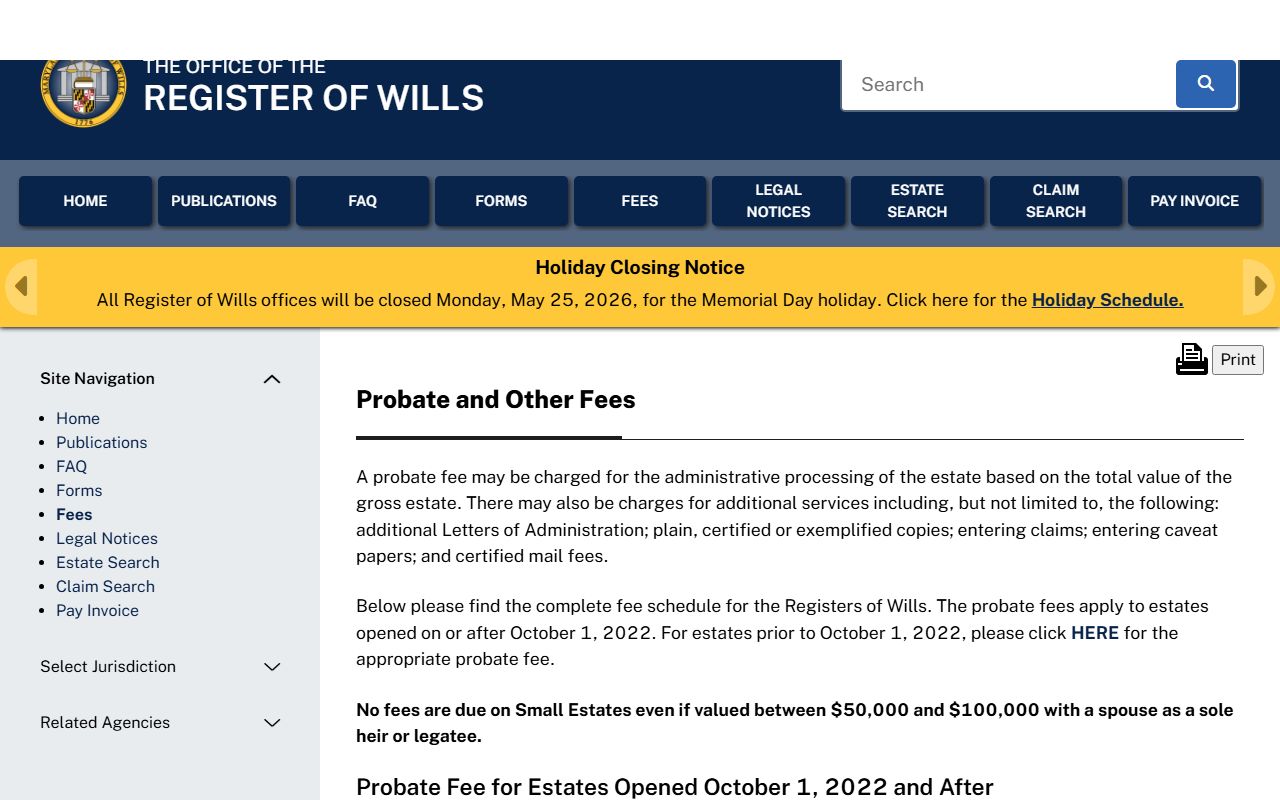
Bring a way to pay when you file or request copies. The office lists the payment methods it takes. A certified copy is the version a bank or another court will accept, so ask for that when an estate document must be official.
Small Estate vs Regular Estate in Anne Arundel County
Maryland sorts estates into two main tracks. The size of the estate decides which one applies. A small estate moves through a short, lighter process. A regular estate takes the full path with an inventory, notices, and a formal accounting. The comparison below shows the key differences.
| Point | Small Estate | Regular Estate |
|---|---|---|
| Estate size | Under the state small-estate limit | Above the small-estate limit |
| Paperwork | Lighter, fewer filings | Full set of forms and reports |
| Timeline | Faster to close | Longer, set by statute |
| Accounting | Simpler or none | Formal accounting required |
| Creditor period | Shorter | Full claim window |
Confirm the current dollar limit with the office, since the threshold is set by state law and can be adjusted. The personal representative picks the right track when the estate opens.
Restricted Anne Arundel County Probate Records
Most estate files are open to the public. You can read a will, see who serves as personal representative, and follow the accounting. But some parts are shielded. The office holds back details that could harm a vulnerable person or expose private financial data. So a file may be open while a few pages stay closed.
Access limits often apply to these items.
- Records that name or describe minors.
- Medical information tied to a guardianship.
- Financial account numbers and other identifiers.
- Guardianship-sensitive filings about a person's capacity.
To view a shielded record you may need to be an interested person, an attorney on the case, or someone the court allows by order. If a guardianship matter crosses into the Circuit Court, the Anne Arundel County Circuit Court rules on access there. For the broader records framework and the office that signs many related filings, see the Clerk of the Circuit Court page.