
How to Search Anne Arundel County Warrants
The main tool is the Anne Arundel County Sheriff active warrants page. It is run by the Anne Arundel County Sheriff and is free to use. The list does not load right away. You must read a disclaimer first, then click "I agree" to open the table. Once the table loads, you can type in a search box, sort the columns, and change how many rows show on each page. The whole list lives on one public web page, so no account or login is needed.
Have a name ready before you start. The list sorts by last name, then first name. A warrant number works too if you have it. The steps below follow the normal flow.
- Open the Sheriff active warrants page and read the disclaimer at the top.
- Click "I agree" to load the warrant table. The list will not show until you do.
- Type a last name, first name, or warrant number into the search box to filter the rows.
- Click a column header to sort by name, age, charge, city, or zip code.
- Change the page length dropdown if you want more than 25 rows at once.
- Use the Submit Tip button on a row if you can help the Sheriff locate that person.
The Sheriff also keeps a main Anne Arundel County Sheriff page with civil process and other unit details. Start there if the warrant page link ever moves.
What the Anne Arundel County Warrant List Covers
The online list is not the full picture, and the Sheriff says so plainly. The database is informational only. It is updated weekly. It is accurate only as of the upload date. No action is taken on a listed warrant unless a Maryland law-enforcement agency first verifies that the warrant is still valid. So a name on the list is a lead, not proof.
The list is also narrow on purpose. It holds only unserved Anne Arundel County warrants that have stayed active for six months or longer. It is not a complete list of every unserved warrant in the county. A warrant that was served days ago may still sit on the list until the next weekly update runs.
Important: The public warrant list is a weekly snapshot of old, unserved warrants only, so a clear search does not prove that no warrant exists.
Anne Arundel County Warrant Search Fields
The warrant page uses a small set of controls. You agree to the disclaimer once, then the table tools do the rest. There is no long form to fill out. The table below lists each control, its type, whether it is required, and how to use it.
| Field / Control | Type | Required | Notes |
|---|---|---|---|
| I agree | Button | Yes | Must be clicked to load the warrant table |
| Table search | Search box | No | Filters the loaded warrant rows as you type |
| Sort columns | Table headers | No | Click a header to sort; default order is by the first column |
| Page length | Dropdown | No | Sets rows per page; the default is 25 |
| Submit Tip | Button / link | No | Opens a tip form tied to that warrant row |
The search box checks every column at once. So a city, a charge word, or part of a name can all pull matching rows. That makes it easy to scan, but it can also return more rows than you expect for a common name.
The Anne Arundel County Active Warrants Database
The public database and its required disclaimer both live on the Sheriff's active warrants page.
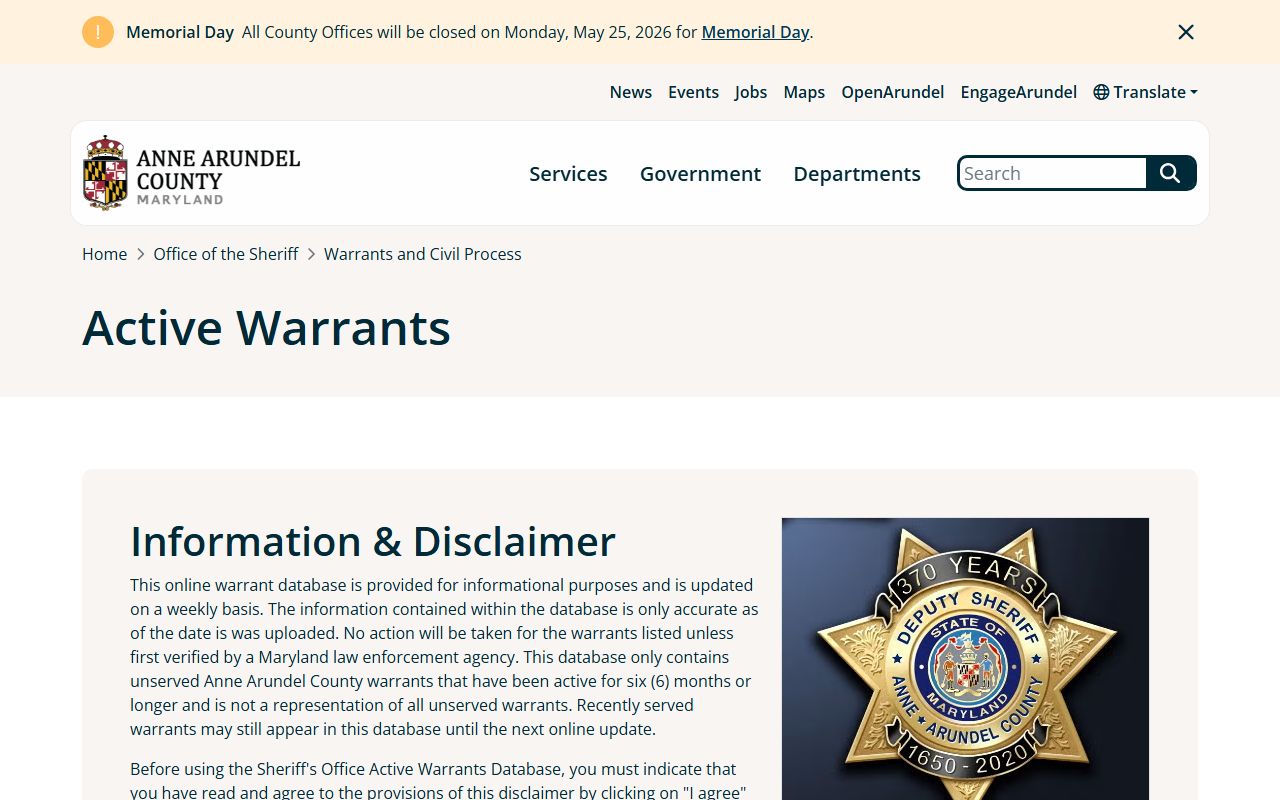
The disclaimer sits above the warrant table, and you have to agree to it before the rows appear. Read it each time, since the warning about weekly updates and verified warrants applies to every search you run.
What Anne Arundel County Warrant Records Show
Each row in the table is one warrant. The columns give a quick read on who the warrant names, the charge, and the last address on file. They do not show case status in real time, and they do not show a mugshot. The list below maps every column the table returns.
- On The Lookout - a yes or no flag the Sheriff sets for that warrant.
- Warrant Number - the court ID for the warrant, such as D07CR23005447.
- Subject Name - the named person, shown as last name, first name.
- Current Age - the age on record for the subject.
- Charge Name - the charge text tied to the warrant.
- Last Known Address - the last street address the county has.
- City - the city for that address.
- Zip Code - the postal zip for that address.
One sample row from the official data file shows how a record reads in full. The two-column table below uses that sample.
| Field | Sample Value |
|---|---|
| On The Lookout | no |
| Warrant Number | D07CR23005447 |
| Subject Name | ABEL, PAUL |
| Current Age | 41 |
| Charge Name | THEFT LESS THAN 100 |
| Last Known Address | 514 CRAIN HWY N |
| City | GLEN BURNIE |
| Zip Code | 21061 |
Note: The address shown is the last one on file, so it may be old, and the named person may no longer live there.
Submitting a Tip on an Anne Arundel County Warrant
The Sheriff asks the public for help locating people with open warrants. Each warrant row has a Submit Tip button. When you click it, a form opens that already shows the warrant details, so you do not have to retype them. You then add what you know and send it. The active warrant tip form is the page that handles this.
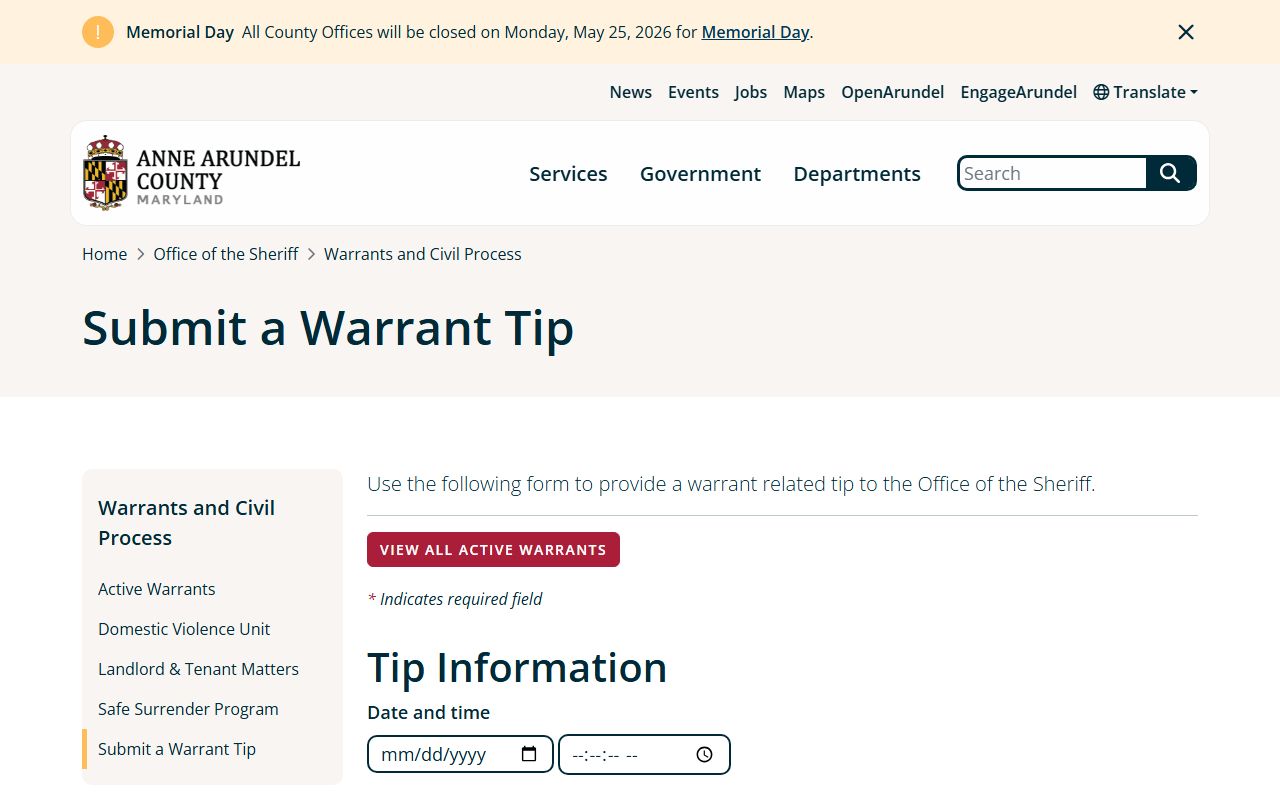
The form prefills and displays the subject Name, Warrant No, Age, Charge, Last Known Address, City, and Zip Code so you can confirm you have the right person. You fill in three things of your own.
- Your Name - your name as the tipster.
- Your Phone Number - a callback number for the Sheriff.
- Please Enter Your Tip - a text box for the tip itself; this field is required.
Two buttons close out the form. Submit Tip sends the tip to the Sheriff. Cancel drops it. The tip box is the only field you must fill in to send.
Types of Anne Arundel County Warrants
Not every warrant starts the same way. The type the public asks about most is the bench warrant. A judge issues a bench warrant when something goes wrong in an open case. The list below covers the usual reasons a bench warrant gets issued in the county.
- Failure to appear - the person missed a required court date.
- Probation violation - the person broke a term of probation.
- Unpaid obligations - the person did not pay a fine, fee, or other ordered amount.
- Contempt - the person ignored or defied a court order.
A warrant can come from the District Court or the Circuit Court. The court that handled the underlying case is usually the court that issued the warrant. The warrant number in the table often hints at the source court and the year. To confirm the case behind a warrant, you can cross-check the name in court records.
Charges tied to a warrant are not the same as a conviction. A warrant only means the court wants the person to answer the matter. For full case history, the Anne Arundel County court records search and the arrest records page hold more detail than the warrant list does.
What to Do About an Outstanding Anne Arundel County Warrant
If you think you have an open warrant, do not rely on the online list as proof either way. The list is a weekly snapshot, and it only holds older unserved warrants. The right move is to verify the warrant through an official source before you act. Several offices can confirm a warrant for you.
- Call a defense attorney, who can check the status and advise you.
- Contact the Anne Arundel County Sheriff, who serves and tracks warrants.
- Ask the Clerk of the court that issued the warrant.
- Reach out to the law-enforcement agency tied to your case.
Once a warrant is confirmed, clearing it usually means facing the court. The person may need to appear in District Court or Circuit Court, depending on which court issued the warrant. In some cases the court allows bail to be posted so the person can be released while the case moves forward. An attorney can often arrange a hearing date and lower the chance of a surprise arrest.
The Anne Arundel County Circuit Court page and the court records page explain how cases move through each court. If the person is already held, the inmate records page shows housing, bail, and court dates.
Posting Bail on an Anne Arundel County Warrant
Bail is the money or bond a court sets so a person can stay out of custody while a case is pending. One point trips a lot of people up. Bail is not paid at the jail. The detention facilities do not take bail payments, so showing up there with cash will not work.
There are two correct places to pay, and the right one depends on the time of day. During business hours, bail is paid at the Clerk's office of the District Court or the Circuit Court that handles the case. After hours, payment goes to the Commissioner's Office instead. The commissioner station tied to the detention center on Jennifer Road runs 24 hours a day, and there is a commissioner at the Annapolis court complex on Rowe Boulevard.
For some warrants a judge sets a dollar bail, and for others the warrant says no bail at all. When a Circuit Court warrant sets a fixed bail or marks no bail, an automatic bail review may not be scheduled, so legal advice matters even more.
Important: Pay bail at the District or Circuit Court Clerk during business hours, or at the Commissioner's Office after hours, never at a detention facility.